
HEYBIM is the specialist in 3D building digitization in France. Laser scanning, point clouds, 2D plans, digital BIM models — the company operates across the country for architects, property managers, insurers and industrial clients. When we started working together in December 2024, the website didn't exist yet. We started from a blank page. The goal was simple and clear: generate qualified leads through SEO.
At Bonu, we launched this project in startup-studio mode. We don't just advise — we build the site, define the acquisition strategy and execute from day one. Here's how we structured HEYBIM's digital presence starting from scratch.
The context: a naturally local market
The building digitization industry has a specific trait: prospects look for a provider near them. An architect in Lyon who needs a 3D scan won't type "3D building scan" into Google. They'll type "3D building scan Lyon". A property manager in Marseille will search "building digitization Marseille". An engineering firm in Normandy will type "3D survey Le Havre".
It's systematic: in construction and technical services, Google search always follows the same pattern — service + location. Our entire strategy is built on this reality.
The local SEO strategy: city by city, department by department
We built a systematic local SEO page architecture. One page per target city. One page per department. One page per region. Each page is optimized for the searches specific to its geographic area: "3D building scan + city", "2D plan + department", "building digitization + region".
This isn't duplicated content with a changing city name. Each page is contextualized: local references, specifics of the local economic fabric, common building types in the area. The goal is to create a page that precisely matches a prospect's search intent in that geographic area.
Result: HEYBIM ranks on dozens of service + location combinations. These are moderate-volume searches, but with very strong purchase intent. A prospect typing "3D building scan Bordeaux" has a concrete project. That's exactly the type of traffic we want to capture.
What you can apply
- →If your business is local or national with a proximity logic, structure your site around local SEO pages. One page per target city or area, optimized for 'service + location'. It's the most direct lever to capture prospects with purchase intent.

The WordPress → Shopify migration (January 2026)
The site had initially been built on WordPress. In January 2026, we decided to migrate everything to Shopify.
The question comes up often: why Shopify for a services site, without e-commerce? Because day-to-day management is incomparably simpler. Content creation is smooth, administration is intuitive, and the HEYBIM team can be autonomous on updates without going through a developer. We add a local page in minutes. We publish a blog post without touching code. We edit a landing page without risking breaking the site.
Shopify isn't reserved for online stores. It's also an excellent platform for acquisition-oriented services sites. We proved it with Flowrette on the e-commerce side, we're proving it with HEYBIM on the lead generation side.
What you can apply
- →Don't underestimate Shopify for a services site. If your team needs autonomy over content creation and you don't want to depend on a developer for every change, it's a serious option — even without e-commerce.
The netlinking work
We rolled out a backlink strategy focused on the construction and building theme. No links bought in bulk on generic directories — thematic backlinks, on sites specialized in the industry.
Within a few months, the site earned 28 referring domains, all from sites related to construction, housing, real estate and renovation: constructions.fr, habitat-durable.com, batimentdurable.com, les-travaux.com, devis-charpente.fr, among others. Relevant links, on sites directly connected to HEYBIM's activity.
The impact is measurable: the average Google position went from 35 in December 2024 to 21 in March 2026. Thematic backlinks helped establish domain authority on queries related to building digitization.
What you can apply
- →Invest in thematic backlinks, not volume. 28 referring domains on sites specialized in your industry are worth more than 200 links on generic directories. Look for sites with real content in your niche.
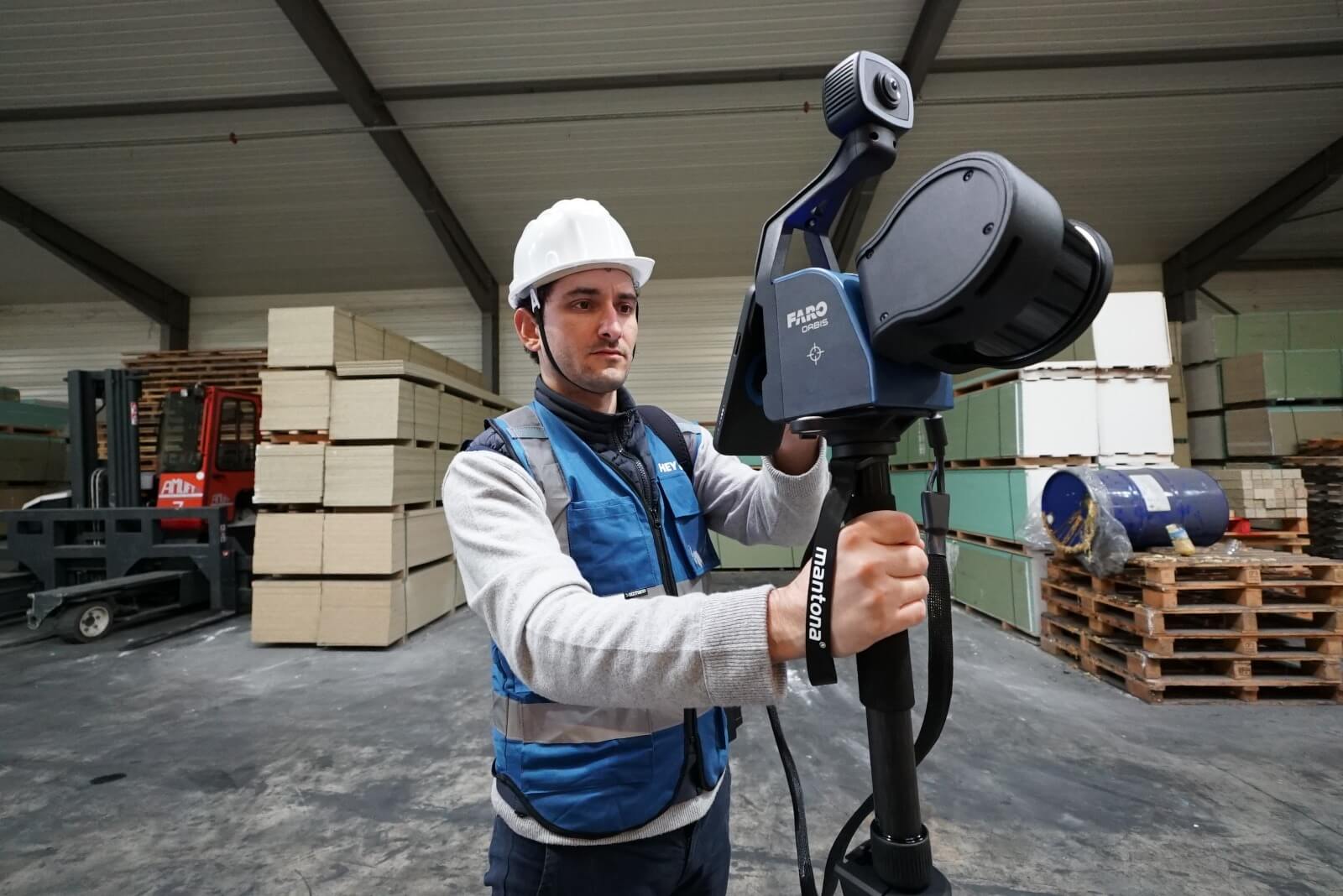
The HEYBIM team in the field with the FARO Orbis scanner
The blog: a long-term effort
We set up regular, expertise-oriented blog content production. Client cases (a survey of a 15,000 m² high school, digitization of a hangar for La Plateforme in Marseille, a survey of the Roy d'Aragon staircase for a local authority), technical guides, educational content around 3D scanning, BIM and digitization.
The goal is twofold: position HEYBIM as the reference on these topics on Google, and feed the site with indexable pages targeting informational queries. A prospect who reads an article on "how to digitize an existing building" is a prospect who, in 3 months, may have a concrete project. The blog creates the first point of contact.
Lead qualification with Typeform
Generating traffic is one thing. Qualifying leads is another. We integrated Typeform as a lead capture tool on the site. Not a simple contact form with name + email + message. A real qualification journey: project type, building surface area, location, timeline, estimated budget.
The benefit is twofold. For the prospect, the form is engaging and smooth — Typeform offers a far better experience than a classic HTML form. For HEYBIM, every lead arrives with enough information to assess the project even before the first call. No time wasted on unqualified requests.
What you can apply
- →Qualify your leads before the first call. A well-built Typeform, with the right questions, saves you time and improves your conversion rate. A prospect who fills in 6 fields is more engaged than one who sends 'Hi, I'd like a quote'.
- →Publish client cases. It's SEO content, social proof and a sales tool — three in one. Every completed project is a potential article that will rank on long-tail queries.


The results in numbers
Google Search Console — heybim.io — December 2024 to April 2026
Positions on local queries (GSC, April 2026):
Month-by-month evolution:
December 2024 (launch)
37 clicks · 3,048 impressions · position 35
March 2025
114 clicks · 5,415 impressions · position 30
October 2025
132 clicks · 5,669 impressions · position 22
March 2026
140 clicks · 7,873 impressions · position 21
April 2026 (ongoing)
position 15.9
Key trends:
- 7,000+ impressions per month on qualified B2B queries — architects, property managers, engineering firms.
- Top 3 on Google for most targeted local queries (Tarbes, Reims, Andorra la Vella, Grenoble, Tours…).
- Clicks were multiplied by 4: from 37 to 140 per month.
- The average position went from 35 to 16 — the site is getting closer to page one on its main queries.
These numbers come from a site that started at zero, 16 months earlier. In a niche B2B market where each lead can represent a contract worth several thousand euros, every organic click carries significant value.
Next steps
SEO laid the foundations. Now we're shifting up a gear with two complementary levers.
1. Launching Google Ads campaigns
The goal is clear: lead acquisition. We're launching Google Ads Search campaigns targeting high purchase-intent queries — "3D building scan + city", "3D digitization + department". The same queries worked on in SEO, but this time with an ad budget to immediately capture prospects in active search mode.
SEO and SEA aren't competitors — they're complementary. SEO captures long-term organic traffic, SEA lets you test new cities quickly and occupy top positions from day one. Combined, they lock down page one of Google.
2. Email collection and Marketing Automation
The second lever is email marketing combined with growth hacking. We're rolling out a targeted, multi-step prospecting strategy:
- →Scraping and enrichment — identifying key targets by profession: construction project managers, architects, engineering firms, property managers. We build qualified databases, enriched with the right decision-maker contacts.
- →Targeted cold outreach — sending personalized email sequences by segment. An architect doesn't get the same message as a property manager. Each email is contextualized to the profession, pain points and relevant use cases.
- →Marketing automation — setting up automated flows to nurture inbound leads. A prospect who fills out the Typeform without following through gets a follow-up sequence. A recurring blog visitor is retargeted with content tailored to their interests.
The goal is to stop relying solely on inbound traffic. SEO and Google Ads capture existing demand. Emailing and growth hacking will create demand by reaching prospects where they are — in their inbox.
What you can apply
- →Don't limit yourself to SEO. Once your organic acquisition is in place, activate complementary levers: Google Ads for immediacy, cold outreach for active prospecting. It's the combination of all three that makes the difference.
- →Segment your prospecting by profession. A generic message sent to 1,000 contacts will always convert less than a personalized message sent to 100 well-targeted decision-makers.
Also read
Flowrette: from €0 to €2M in revenue, then exit
How we built an e-commerce brand from scratch: #1 SEO on Google, Klaviyo CRM, migration to Shopify, all the way to the sale.
Your project deserves the same rigor. Local SEO, Google Ads, growth hacking, emailing, Shopify — we put the expertise we've built in the field at the service of your digital growth.
Discuss your project